
The Doshas
How they manifest in us

Ayurveda rests upon the tridoshic concept, and here we’ll introduce the basic theory and science behind the doshas.
The doshas are bio-energetic characteristics which make up our individual mind-body type. They are formed from the panchmahabhutas or 5 great elements, namely ether, air, fire, water and earth. Vata dosha is formed of ether and air elements, pitta dosha is formed of fire and water, and kapha dosha is formed of water and earth elements.
We need all 3 to exist in human for and so each of us have all 3 doshas in our makeup in varying proportions. An individual can have one dominant dosha, and so can be said to be a vata type, pitta type or kapha type person. It is also common to have two dominant doshas, and therefore a dual type of vata-pitta, pitta-kapha, or vata-kapha. A tri-doshic type is also possible where all 3 doshas are equal, though this is an extremely rare occurrence.
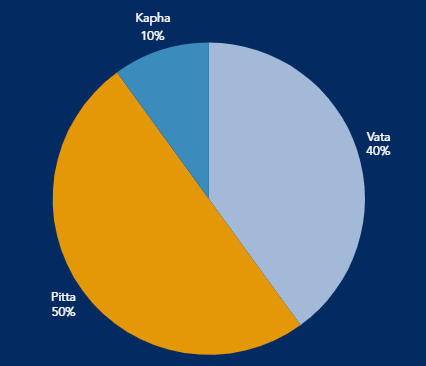
The purpose of ayurveda and its methods is not to achieve an equal balance of vata, pitta, kapha, but to maintain balance of one’s own true nature. As we can see below, someone may be 50% pitta, 40% vata, and 10% kapha. We do not want to make these 33% each, but ensure that an individual is maintaining the balance of 50-40-10.
The Gunas
In order to understand the doshas better, ayurveda provides a description of the attributes and behaviours of the doshas. This is called the gunas which are 10 pairs of opposite qualities:
Hot - Cold
Oily - Dry
Heavy - Light
Gross - Subtle
Dense - Flowing
Static - Mobile
Dull - Sharp
Soft - Hard
Smooth - Rough
Cloudy - Clear
Let’s see how these attributes can help us describe the doshas, beginning with vata dosha.
Vata Dosha
Ayurveda ascribes these gunas to vata doshas: dry, light, cold, rough, sharp, mobile, subtle, hard and clear. And so a vata-dominant person may experience dry and brittle skin, hair, and nails.

They will have cold extremities, ie hands and feet, and do not tolerate cold or windy weather too easily. They already tend towards cold and dryness, so add extras of these will only make things worse for vata people. They will tend to have a thin and slender body frame, and can be either short or tall. They have a variable appetite, often snacking on nuts, seeds, crisps throughout the day.
Vata is made up of ether and air elements, and so vata people will tend to experience more air and dryness in the body – this can show as bloating and constipation, but can also manifest mentally as quick thinking, and flowing creativity. Too much of this can create excessive thinking and concentration and even obsessive behaviour and paranoia.
Vata type people will often be energetic and restless, constantly wanting to move and change position, often to be found talking and laughing excessively, more often than not too much! And their sleep will be light, irregular and often disturbed, regularly waking up easily during the night.
They learn things quickly, but often have short memories and can mentally and emotionally experience shyness, nervousness and tend towards fear and anxiety.
Pitta Dosha
The attributes of pitta dosha are oily, sharp, hot, light, unpleasant odour, mobile, liquid.
Pitta type people will have a medium or average frame with a warm and soft complexion. They will have more of the fire element, so will therefore tend towards feeling hot and be more prone to inflammation. They have a very strong appetite, eating 3 meals a day and if they don’t eat the succumb to being hangry!

They have a sharp and intellectual mind, learning things very easily. They have a strong attention to detail and perfectionist tendencies. They are serious and determined people, who are highly successful and find it easy to achieve their goals and dreams, and are always looking for the next challenge. They are confident and fearless and make for great leaders. They love living in comfort and enjoy luxuries of all kinds. They can be quick to anger and experience jealousy and envy towards others.
Kapha Dosha
The attributes of kapha dosha are cold, heavy or dense, oily, dull or slow, sticky, soft and firm or static.

Those of a kapha type nature have a larger body frame and have a soft and oily complexion. Kapha dosha is responsible for immunity in the body and so kapha dominant people have very good immunity themselves and rarely find themselves out of balance. They are known to be very stable, calm and polite and more often than not are thinking about and caring for other people before themselves. They have a gentle nature and are full of heart.
Kapha people love their food, but kapha is also slow, so they have slow digestion and can put on weight easily. Slowness can also be experienced mentally, often taking a long time to learn things, but they have a very good long-term memory. Like vata type people, they are cold, however the difference is that vata types can experience cold and dry together, whereas as cold and wet is characteristic of kapha dosha.
Kapha people are well-natured and are grounded, often acting as a counsellor to vata and pitta type people. By their own nature, they are more likely to experience sadness, grief and depression.
Prakriti or Vikruti?
The doshas are dynamic, and it’s important to make a distinction here between prakriti and vikruti. Our prakriti is our natural state of being, when the doshas that we are born with are in perfect harmony with each other. In modern parlance, we might call this homeostasis, where everything is working perfectly and no dis-order is being experienced.
Then there is the state of vikruti. This is when the doshas are imbalanced, and this is what ayurveda addresses when seeking to rebalance. The imbalanced state is addressed and when this is achieved, the practice of preventative care in line with one’s vikruti, natural state can be carried out.
We are constantly impacted by different factors, including diet. Diet is not just what food and liquid we take in through the mouth, but also our mental and sensory diet too – what impressions are we taking in that all need to be digested? Lifestyle practices are another key factor, as well as the environment and our surroundings that we live in. The time and seasons also play a major factor in maintaining health.
So what might an imbalance of each of the doshas look like?
Ayurveda says that imbalance vata dosha may look like:
Intolerant to cold
Restless (body and mind)
Constipation, gas
Craving sweet, sour, salty food
Stiffness/pain in joints
Sensitive to noise, touch
Lack of concentration
Imbalanced pitta dosha may look like….
Intolerant to heat
Burning sensations
Hot flushes
Sensitive to light
Loose stools
Increased sweating/foul odour
Skin issues
Acid reflux
Irritable
Short temper
Imbalance kapha dosha may look like…
Cold skin
Loss of appetite
Weight gain
Feeling heavy/sluggish
Inactive
Increased bodily secretions
Lack of drive
Increased attachment to things
By having a good understanding of the doshas, our own makeup and imbalance, we can know how to balance ourselves through correct diet, and lifestyle practices.